

Extended Article
A Conversation with Stephen Hirtenstein,
Author of The Unlimited Mercifier, The Spiritual Life and Thought of Ibn ‘Arabi
The Insight Newsletter’s editorial team members Victor Sinow and Ashley Werner conducted the following interview, which has been edited for clarity and brevity. This article was first published in Sufism: An Inquiry, Vol. 21.2.
Insight: What inspired you to write The Unlimited Mercifier?
Stephen Hirtenstein: It’s funny you used the word “inspiration.” It was simply a request somebody made to me to write a book about Ibn ‘Arabi. My immediate answer was “Yes.” I wanted Ibn ‘Arabi to tell his own story himself. There are many stories about him written by later generations. I wanted primarily to go back to as far as possible to the text he wrote and work from that and not at all from what people had made of him. My feeling was always that he speaks directly and personally to the individual reader.
In that moment of saying yes, many things in my life changed. I thought, “how am I going to approach this? Where am I going to start?” One morning, I was in that state between sleeping and waking, and suddenly I saw a double helix – one strand was life and the other was thought. I could see there was a chapter of life, followed by a chapter of thought. One of the peculiar things was that I saw or heard the titles of all the thought chapters. I came to at that point and grabbed a piece of paper as quickly as possible and wrote them down. It was very clear to me that I just had to do what was asked of me rather than create something.
It was important to me to convey something of an outer life and inner life going alongside each other. That is easy to say, but it’s very difficult to do, because when you look at Ibn ‘Arabi’s life, from a very early age he was a person of knowledge. He had an experience that completely transformed him, which he describes as ‘turning to God’. Then the individual life becomes almost symbolic, passing through things in a life of meaning – this is how a plant or a tree grows, it’s a completely normal natural process.
Insight: Do you want to tell us anything about what drew you to Ibn ‘Arabi?
Stephen Hirtenstein: I was at university when I first heard anything about Ibn ‘Arabi. I came across a poem by Ibn ‘Arabi which I remember to this day, because it had such an impact on me. “My heart has become capable of every form…” What struck me most was it articulated something which I knew was absolutely true on one side, and which intellectually I didn’t understand. My heart said, “Yes,” and my head said, “What?” The dissonance was what interested me, because I thought, “How come I understand it in one way, and don’t understand it in another way?” That was where it began.
Insight: Can you tell us why you chose The Unlimited Mercifier as the book’s name?
Stephen Hirtenstein: Ibn ‘Arabi says, “God has made me rāhim mutlaq”. Rāhim is an active quality of showing mercy or compassion. The context in which he says this is part of a longer quote about the Throne of Existence—which is everything. Sitting on this Throne is the Divine Compassion itself. This throne, he says, has pillars, and his pillar is the pillar of the Treasury of Mercy, and “God has made me an Unlimited Mercifier”, unlimitedly merciful towards everyone. This evokes a Qur’anic principle, where God says to Muhammad, “We did not send you except as mercy to the universes.” So, the only reason for the human being is to be mercy to the universes.
The book’s title is both about how Ibn ‘Arabi describes himself and about the principle of being human. In the end, human beings are sent with the potential to be mercy to the universes. Our task is to learn how to allow that rahma, that mercy and compassion, to express itself.
Insight: What are the benefits of reading the works of Ibn ‘Arabi today?
Stephen Hirtenstein: Ibn ‘Arabi says that he did not write anything except out of Divine Inspiration. He and his companions were very careful to keep this written form of inspiration intact and available. It was an extremely important part of his mission. Why? Because he’s explaining the meanings of the Islamic tradition, and in fact, the tradition of all human spirituality from its beginning to its end. He had this task of not just describing the historical evolution of saints and prophets, but of going into the core of what it means to be human. His book Fusus al-hikam, Gemstones of Wisdom, is a book about the human being, from our Father Adam – who is our prototype – all the way through to the best exemplars of humanity, which we call prophets, who are tasked with delivering a message to humanity. Each one is shown for the wisdom they are contributing to the human enterprise.
In the end, the study of Ibn Arabi’s work becomes the study of oneself, one’s environment, what it means to be a human being. So how can it not be relevant and of benefit?
Insight: What are you working on now?
Stephen Hirtenstein: Many projects! Including a second edition of the Unlimited Mercifier – although I’m generally happy with it, there are some details that need to be amended in the light of new research.
I’m also working on a new book with my colleague and friend Pablo Beneito, with whom I wrote Patterns of Contemplation (about the extraordinary Blessing Prayer of Effusion, al-Salat al-Faydiyya). We are translating a series of poems that Ibn ‘Arabi wrote on the individual letters of the Arabic alphabet, trying to give English readers an entry point into Ibn ‘Arabi’s remarkable poetry, through the resonances, the musicality, the harmonies, and the various features of each letter.
There’s a lot more study now of Ibn ‘Arabi’s writing, but a lot of it tends to be as if it’s an academic subject. But my feeling all the way along has been that this is not what’s most important. If you are introduced to a river flowing into the ocean, you can spend your time standing on the bank looking at it, measuring it. But at some point, you stick your foot in it, maybe swim in the shallows a little, maybe get washed out to sea. The whole point is learning to accept the full weight of the river’s flow.
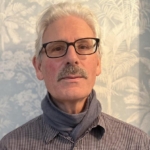
Stephen Hirtenstein is an author, translator, editor, founding director of Anqa Publishing and head of the Muhyiddin Ibn ʿArabi Society Archive project. He also teaches for the University of Oxford and works for the Institute of Ismaili Studies in London.